
Trace Former Jackson County Owners by Transfer
A backward deed-chain table keeps every step honest. Fill in a row only after reading the matching deed records entry or instrument itself, and record the exact book, document, or first-page label beside each name.
| Transfer Date | Grantor to Grantee | Deed Type | Book/Page or Document |
|---|---|---|---|
| Newest recorded date | Prior owner to present grantee | Read the instrument label | Copy the portal's exact reference |
| Prior recorded date | Earlier grantor to that prior owner | Warranty, quitclaim, or other stated type | Match description and pages |
| Repeat backward | Each predecessor to successor | Do not infer type from names | Preserve old book labels |
Tax history can hint at a former owner. It is not a deed chain. Use the tax roll only to surface a name or date. Then test that lead against recorded conveyances.
GIS PreviousOwner works the same way. It offers a chronology clue, never a complete list of prior owners. A sound chain accounts for every change of ownership through a recorded instrument. That instrument must be tied to the same land. Mortgages, releases, judgments, easements, and plats can all touch a parcel without transferring full ownership. Keep those labeled separately in your property search.
Start the Jackson County Online Chain in 1947
Jackson County Probate Records states that deed-mode coverage begins June 1, 1947. Treat that date as an online-index cutoff, not proof that earlier deeds are missing. Search the portal by grantor or grantee and date, then carry document, book, page, instrument, and recorded-date fields straight into your working chain.
Coverage line. The online deed index starts June 1, 1947; older prior owners require courthouse books or historical finding aids.
An image may not be scanned. The index itself is free. Portal documents run $1 per page plus the vendor fee. For tracing prior owners, the goal is simply to identify each transfer. You do not need to rebuild the deed-copy ordering process.
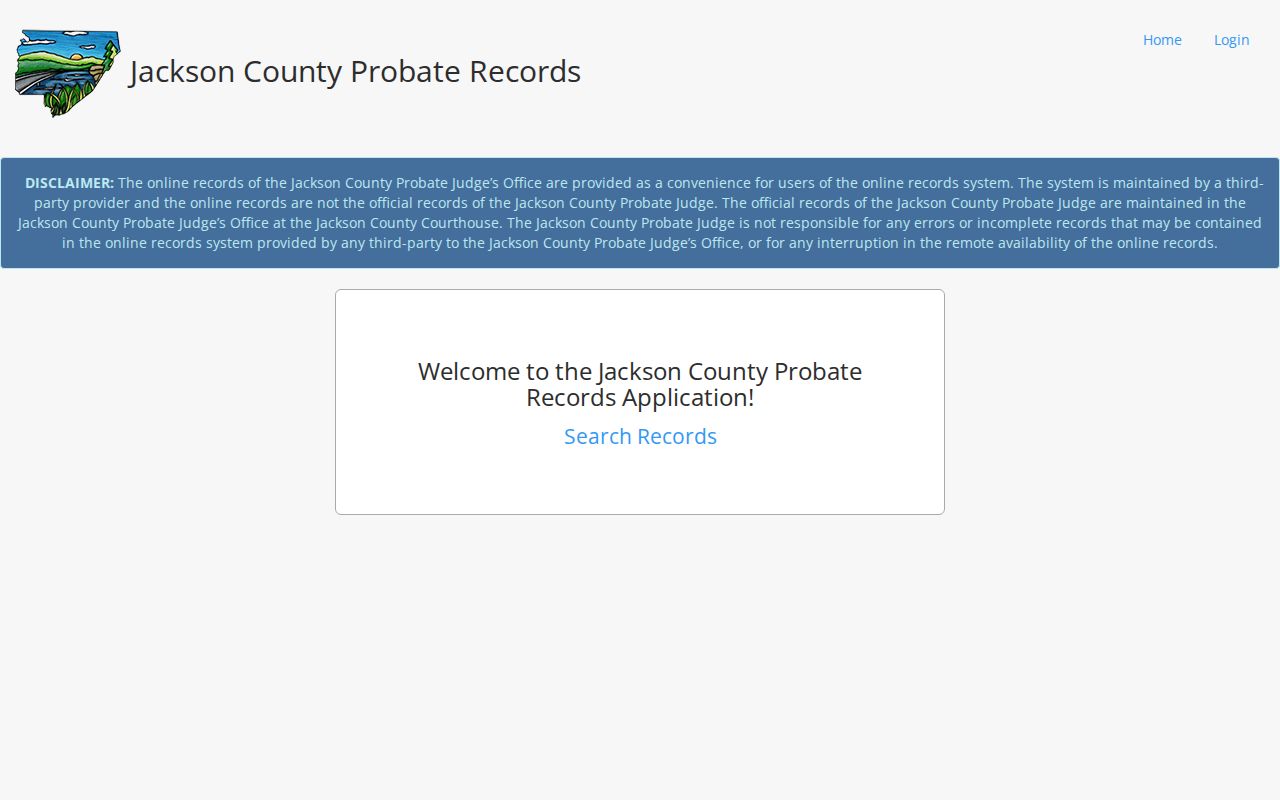
The official Probate search page displays the index route that starts the backward chain.
Carry each match's party, date, and reference into the next earlier search.
Reconstruct the Jackson County Deed Chain Backward
The present deed bridges you to the first previous owner. Keep the legal description fixed in view as the names shift. One party may have bought or sold several tracts in Jackson County, and the description is what proves the land match.
- Find the current owner's acquiring deed with that owner as grantee.
- Read the grantor, legal description, signed date, recorded date, and reference.
- Search that grantor as an earlier grantee and locate the matching land.
- Repeat, testing estate, trust, married-name, initial, and entity variants.
- At the online cutoff, continue through Probate Office books and finding aids.
- Grantor / grantee
- The conveying party and the party receiving the stated interest.
- Chain of title
- The linked sequence of instruments affecting ownership of the same land.
- Reverse index
- An index organized to help trace a party on the receiving side of a transaction.
- Quitclaim / warranty deed
- Different deed forms whose exact legal effect should not be guessed from an index label alone.
Note both signed and recorded dates at every step. An instrument can be signed years before it is recorded. GIS keeps those fields separate. Order the public sequence by the recorded timestamp. Retain the signed date as document history. When deeds overlap or descriptions diverge, halt the name chain and resolve the land match first.
Match Jackson County Legal Descriptions Across Generations
Street addresses get assigned, renamed, or reformatted long after a conveyance. A description built on section, township, range, fractional section, point of beginning, and distance calls is the stronger continuity test. Parcel cards, GIS, and deed records may abbreviate or punctuate that language differently, so weigh substance over typography.
Deeded acres, calculated acres, stated area, and GIS ACRES are distinct fields. A gap between them may reflect survey method or rounding, not an encroachment. Pull the deed or survey whenever the chain turns on a boundary.
A rural Jackson County description shows the method's value. It relied on section, township, range, a partial quarter-quarter, and calls returning to a point of beginning. An older deed may state the same tract with expanded wording or different punctuation. Compare the substantive calls side by side before concluding two records describe different property.
Search Jackson County Previous Owners Under Name Variants
Former-owner research often stalls at a name change, not a missing deed. Search name variants: initials, suffixes, spouse names, estate wording, trusts, companies, ET VIR, ET UX, trustees, and personal representatives. Try spouse names and estate wording too. Run an estate name in probate-case mode. Run it in deed mode as well, since opening an estate does not itself convey the parcel. A blank short description is a reason to pull the image, not to toss the result. Pull the image and check the full document. Names and dates can match while the land does not. Always return to the legal description and document reference.
Explain Jackson County Boundary Changes With Plats
Recorded plats, easements, restrictive covenants, and conveyances can explain why one older tract became several lots, or why access crosses a neighboring parcel. Probate search modes include plats and other recorded instruments. Match subdivision, lot, block, parcel, and deed book/page references wherever they appear.
GIS Subdivision, SubLot, and SubBlock fields may sit blank for rural or metes-and-bounds land. Their absence does not end the chain. Continue with section-township-range and deed descriptions instead.
Carry Prior Jackson County Owners Into Early Deed Books
The Jackson County Historical Association Deed Book B index covers 1846 through 1849. Its Deed Book E finding aid covers 1834 through 1835. Preserve those labels and years exactly. The non-sequential letters and dates warn against inventing a smooth volume chronology.
Treat these association indexes as leads, not certified land records. Reconcile names, tract clues, book labels, and pages with the Probate Office or archives. Alabama Secretary of State land resources can extend the story before county conveyances began. Original patent or tract records can do the same.
The Revenue page also describes a historical database of old maps. It includes plats, topographic maps, and other county documents. Those materials may clarify roads, place names, and tract context. They are not a deed index and cannot bridge a missing conveyance. Compare an old map with current GIS for orientation only.
Know How Far Back Jackson County Ownership Records Go
How far back can you trace a Jackson County deed chain? There is no single start date. The online portal reaches 1947, and the two JCHA indexes open windows into the 1830s and 1840s. Older ground is covered by courthouse deed books, Alabama land records, State Archives material, and federal patent or tract sources, each filling a different stretch.
Jackson County has no documented courthouse-fire loss and no complete microfilm inventory. So do not assume either one. Instead, state the last instrument you can prove, name the next repository you will check, and record an honest gap whenever the sources fail to connect.
For paper work, visit the Probate Office at 205 Liberty Lane in Scottsboro, call 256-574-9290, or fax 256-574-9318. Bring the last known names, rough dates, the legal description, and any book or page clues. A focused request like that beats asking staff for a full house history.
Lawful use. Trace former Jackson County owners for house history, inheritance, title, or land diligence, never to track or harass a living person.
A good research log records everything. List each portal mode, date range, name spelling, and book checked. Include searches that came up empty. That habit keeps later researchers from reading an unsearched spelling as a records gap. It also marks the exact point where the chain moved from the online system to paper books, association indexes, or patent and tract sources.
Tax, map, and court records work best in supporting roles. A tax owner can narrow the likely date of a change. A plat can explain how the parcel was divided. A probate case may identify heirs. A circuit case can expose a quiet-title or partition fight. None of these belongs in the chain as a transfer row on its own. A deed, decree, or other controlling instrument must actually link the prior owner to the next one.
Original land context needs special care. A federal or state patent is not a private conveyance. Patent and tract sources explain the first grant. County Probate books carry the land transactions that followed. The finished chain should show both continuity and doubt. It should list proven prior owners in order, with a supporting reference for every step. It should also show a candid break wherever the evidence does not connect.